Welcome to my first post in My Messy Desk Diaries (M2D2)! I would like this series to be a more mundane blog of the goings-on of my—as you guessed it—my desk. From productivity to software, fountain pens, ideas on tech, and the like, I hope to give such thoughts a separate space from a more cranial type of writing. The middle of March may just be a good time to start this. For some, this weekend means Q1 is about to end (along with the energy we imbued our New Year’s resolutions), while for others, Spring is right around the corner. What an opportune time for a reboot, starting with my personal unending battle of the digital v.s. the pen and paper for productivity.
As I was optimizing my digital stack—the software, subscriptions, and services I use every day—I had to pick the brains of the computer programmers close to my life. They graciously did away with the more complex languages of tech, but they noted that I’m the type to try and adopt new tech, and sometimes ahead of them. Who doesn’t love tech! And yet, here I am, a newcomer in the realm of fountain pens and still struggling to pronounce Leuchtturm1917. I’ve made numerous experiments in both the digital and analog worlds, and I’d love to share how I feel about these paradigms.
The Digital and the quests of Life
How does a prisoner handcuffed at the back of a wagon become the greatest avatar of Akatosh, a unifier against the Aldmeri Dominion, and bane of all vampires? The Dragonborn of Skyrim is a product of quests. Decisions on the smallest side quests to the overarching main quests, the shape of Skyrim is based on how we did with our quests. Isn’t it the same in the game called Life with these small side quests of cooking food for our parents, to the main quests of applying for scholarship or job that will improve our prospects in life? Except, Skyrim has quest markers and Life has not. Or so I think.
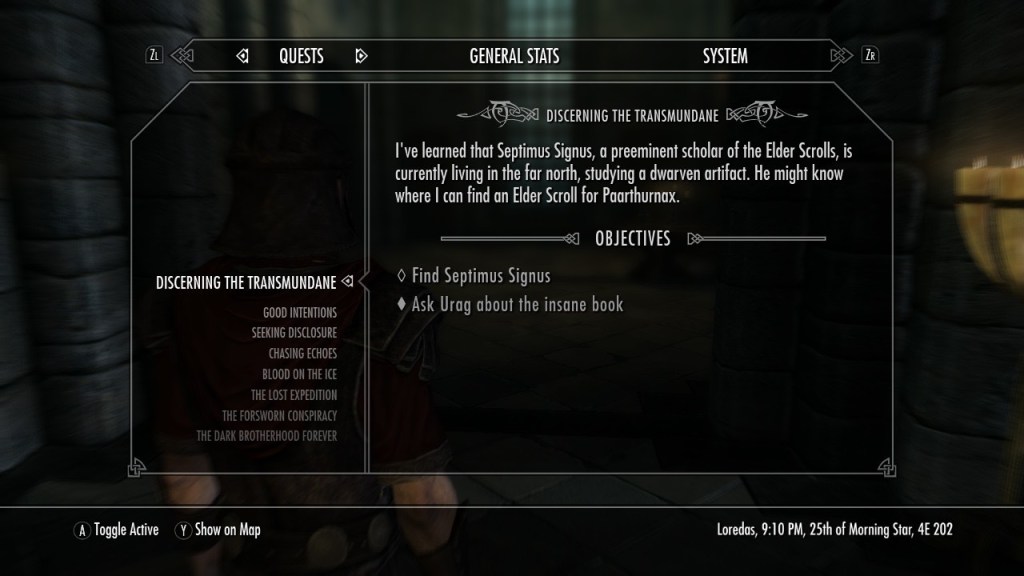
As a gamer at heart, I view my digital tools as a way of managing the different quests in Life. Some quests have neat progressions, while some are open-ended and begging for a follow-through. In the same way that a (good) game’s quest system keeps track of the number of requisite items I have acquired, or the steps I have to accomplish, so does my use of the reminders, calendar, and the like in Life.
Before the advent of Notion, my life dashboard was Trello—a kanban-based productivity app. In a previous job, I’ve broken down complex projects into actionable parts, kept track of moving and team-oriented parts, and earmarked what I accomplished for my monthly accomplishment reports. This was how I helped roll out the current e-tricycle service in Intramuros. In my personal life, this was how I took note of what I lacked when I first got rejected in my application for a scholarship in Japan, and how I bounced back and broke down the application process that got me into 東京大学 (The University of Tokyo). The digital allowed me to accomplish many important quests in Life by monitoring milestones, getting pinged by your phone for deadlines, and seeing such items vis-a-vis the calendar. These are more difficult in an analog system as my notebook won’t send notifications, nor can I rearrange its pages to sort pages based on projects (unless I use ring binders, bane of lefties). The digital is time-critical and scalable and it’s more than that.

“What is the most important role of a project manager?” asked our project management instructor back in college. We gave the smart answers you’d expect from a college junior: a leader or a decision-maker. In her years of experience, to which I have always agreed with and more so with experience, the better answer is this: a historian. As leaders, decision-makers, as managers of projects, being a historian means building organizational knowledge where we can base our decisions on, reference what happened before, and provide a baseline that is crucial in creating assertions of impact and significance. Be it at work or our personal lives, being a historian allows us to look at our growth, see where we can improve, and—most importantly—when to forgive ourselves.
I find that the digital stack is the best to enable the historian in our lives. By pulling different notes, taking stock of what changed and when, we can see how many times a project moved its deadline (and hopefully why), and from there, find ways to get things done on time. By compiling attachments, dates, and links in our digital arsenal, our quests become living documents that grow as Life demands them. And sometimes, when so demanded, sharable to others. With digital tools, we can create a second brain for our lives or organizational history for our work that is adaptive in the new normal that tethers more and more work to the internet. But if the digital is this modern, shiny thing (spurred by the race to the top in Silicon Valley) why am I even in a conundrum?
A cannonball moment for Trello
When I got back from Tokyo in 2018, my work has primarily been work-from-home. Before WFH became all the rave in 2020, I’ve been there. But as the extended quarantines in the Philippines blurred the days from the weeks, the weeks from the months something in my digital stack snapped altogether. Who knew that inundating our eyes with light from our screens would accumulate into sleepless, anxious nights? Then came a certain reckoning. On the one hand, I sought to tighten the security of my digital stack as work more and more demanded such. But on the other hand, I finally came to terms that “if something is free, you are the product.”
One day, the Microsoft Authenticator I’ve been using for months in my then daily driver (a Note8), started spewing sync errors. Confident that Microsoft has synced my 2FA tokens in the cloud, I logged out and back again but to my horror, none of the tokens were saved at all. As a purely online platform, I had no recourse in recovering access to my online login accounts. While I was lucky to regain access to most of the accounts, one platform was impossible to recover: Trello. That’s partly my fault for not securing recovery codes when I trusted Microsoft Authenticator’s ability to back-up everything. But I believe it is also partly Trello’s shortcoming to not provide any option for proving ownership of an account to reset such a security option. Not only can I no longer trust that data in the cloud—the backbone of most of our WFH wonders—will be synced properly all the time, but storing data in the cloud is ceding its ownership to the handlers of this cloud. Suddenly, the years worth of second brain and organizational history (thankfully no longer necessary to be used at that time) that I cultivated, is gone from the ownership of my account. Thankfully, I was still logged in the mobile app to transfer some boards to another account. It’s one thing for me to learn to secure recovery codes, but it was also a reminder to seek technologies that are offline first. And I already have that in the form of pen and paper.
The Analog: days of future past
For the longest time before I left for Tokyo, my go-to pen was the Muji 0.5 Blue Black gel pen. I traded it for the digital trappings of the Note8 and the Surface until I got reintroduced to fountain pens. I had a mentor who would only sign letters with a fountain pen, and back then, I didn’t understand such preference nor the rigor of constructing one’s thoughts before committing to writing. But when I was in Tokyo, I asked a lawyer if a fountain pen is a lawyer kind of thing and she happily indulged me with Platinum Preppy to see it for myself. There was no turning back since then, and it happened in one of the best countries to start a fountain pen habit (or to some, hobby).
There is something special with a writing instrument that effortlessly lays down its ink while being non-disposable. It’s not every day that I find a tool that is, at once, ecological, functional, and elegant. Tokyo happens to be a great place to start such a fountain pen journey as FPs work great in writing Japanese characters and Japan is home to Sailor, Pilot, and Platinum—three (3) renowned brands of the writing instrument. Ginza’s Itoya even has a whole floor dedicated only for fountain pens! Down to the rabbit hole I went with this hobby as I learned to appreciate inks and high-quality paper, such as the Leuchtturm1917, and Rhodia.

Since childhood, I have always used pen and paper for taking down notes. But as I dipped my wallet further in the world of fountain pens, I admittedly sought more ways to extend its usage beyond notes. That’s when I learned the power of journaling and, later on, it also introduced me to the whole idea of pen and paper productivity. In high school, we’d keep this large notebook to track what we learned for the day and the things we have to do for school. In a sense, this was my very first foray into analog productivity. I did the same in college with the power of simple and straightforward checklists. This was until Trello came and showed me new ways to deal with complexity—or so I thought.
Losing access to Trello launched this whole project of experimenting on new ways to be productive. For the pen and paper enthusiasts, bullet journaling, strike thru, and other analog paradigms now show that, as with most things in life, less is more. There is a certain magic of being to immediately capture one’s thoughts, cross them out, doodle when necessary. By creating a personal syntax for one’s text, a person can create a system to reference and index written notes, move tasks, and even plan. There are also health benefits to the analog system. Listing down “the rocks” or the goals for the next day with a pen a paper accomplishes this twin goal of eliminating sources of blue light before sleeping while also planning in the evenings. This habit also flows nicely before or after a journaling session.
Outside the strict realms of productivity, the magic of writing is that it encourages being intentional, and yet is an act of letting go (of one’s thoughts). A white screen often encourages either verbal diarrhea or a mental block, a problem tamed by the immediacy of letting go of one’s constructed thought in the physical act of writing. This confidence in the act and form of writing helped me through Exam 3 of 5 of the Foreign Service Exam. It was a three-day written exam that made me put my fountain pens through their paces (imagine going through half a fully-inked TWSBI Eco each day)!
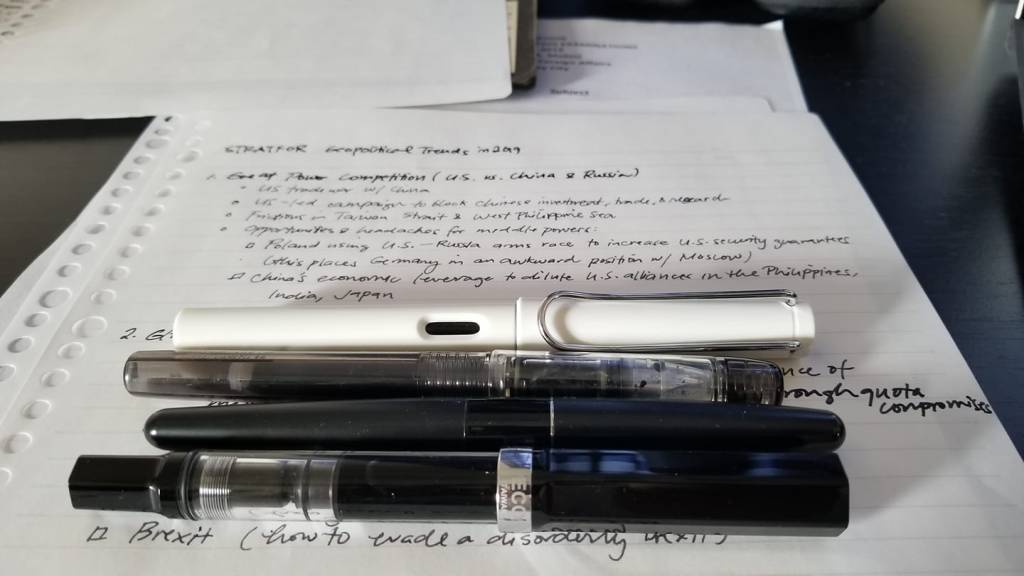
Writing things down also guarantee that they remain mine—no servers (of another person) that maintain it, no ads or some business model trying to earn from it. Unless somebody sought to steal my notebooks, there are no problems of my content suddenly being accessible to another person, inadvertently with a bug nor intentionally with a privacy breach. Journaling and keeping tasks in the likes of Trello, Notion, or Evernote mean that somebody maintaining the service could peruse the contents we often try to keep to ourselves. It happens that as you climb the career ladder, you increasingly get access to data that you have to protect.
Finding the balance
And thus here I am today, having not fully committed once again to either form of productivity. Often, I explore new productivity software while being cognizant of privacy and security. Apple Reminders and Omnifocus are the current “flavors of the month,” with the former being a product of a privacy-focused company and the latter offering end-to-end encryption.
I still utilize my physical notebook with a modified combo of systems. I start the week with a page meant as a parking lot for the tasks of the week, then starting a new page with each day and listing down my tasks. Personal tasks go to the bottom of that daily page and work tasks start from the top; meanwhile, a “vault” is at the back of the notebook for matters that do not have any set deadline. My handwritten journals complement my productivity process as well.

Both systems work, sans the lack of notifications and scalability from the notebook, nor the speed and simplicity of writing things down with a pen. How about you? How are you dealing with the quests of Life? Looking forward to learn from your productivity system!
 Elroy Rendor
You must be logged in to post a comment.